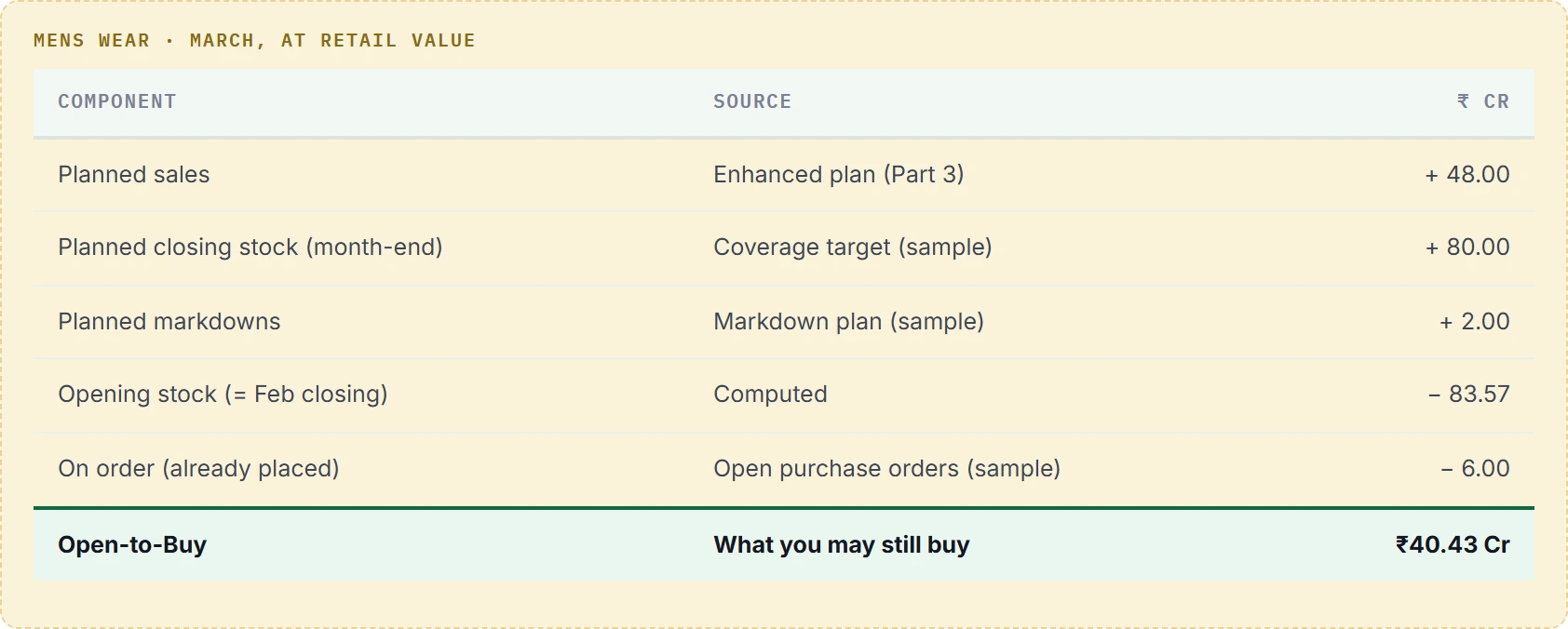
The fastest way to overbuy a store is to hand the buyer the sales plan. It sounds almost responsible: the division is planned at ₹48 crore for March, so go buy ₹48 crore of stock. Except the division is not starting March empty. There is ₹83.57 crore of inventory already on the floor at retail value, and another ₹6 crore already ordered and on its way. Buy to the sales plan on top of all that, and the season ends the way seasons like that always end: racks of stock, a clearance calendar, and a finance meeting about working capital. The number that prevents it is Open-to-Buy, and it is the only number in the whole planning cycle a buyer actually spends.
The equation that closes the loop
Open-to-Buy is bookkeeping applied to ambition. It takes the sales plan and asks the accountant's question: given what you want to sell, what you want to be holding at month-end, what you'll give away in markdowns, and everything you already own or have committed to, how much are you actually allowed to add?
Walk the worked example in the table. Planned sales, ₹48 crore, comes straight from the reconciled plan. Planned closing stock, ₹80 crore, is the coverage you want standing when April opens, because a store that sells its last unit on March 31 has also ruined its April. Planned markdowns add ₹2 crore, stock that will leave at a lower realized value but leave nonetheless. Then the two subtractions that do the disciplining: ₹83.57 crore already owned, ₹6 crore already on order. What remains is ₹40.43 crore. That is the buy. Not ₹48.
Why buying to the sales plan breeds dead stock
Every rupee committed above OTB has to go somewhere, and it only has one place to go: inventory the plan never asked for. It shows up first as a fat closing-stock line, then as lagging sell-through, and eventually as the two tails we've written about before: the dead stock that quietly stops selling at full price, and the markdown budget that grows to move it. Remember the best-seller that moved 2,518 units at 44% sell-through? That is what an OTB failure looks like at SKU level: real demand, bought at twice its depth.
The discipline cuts the other way too. When sales run ahead of plan mid-season, OTB opens up, and that surplus is the earliest, cleanest signal to chase: reorder the fast movers while the season can still absorb them. OTB is not a brake. It is a throttle that works in both directions, provided someone recalculates it monthly instead of filing it in the season binder.
Where the division's number comes from
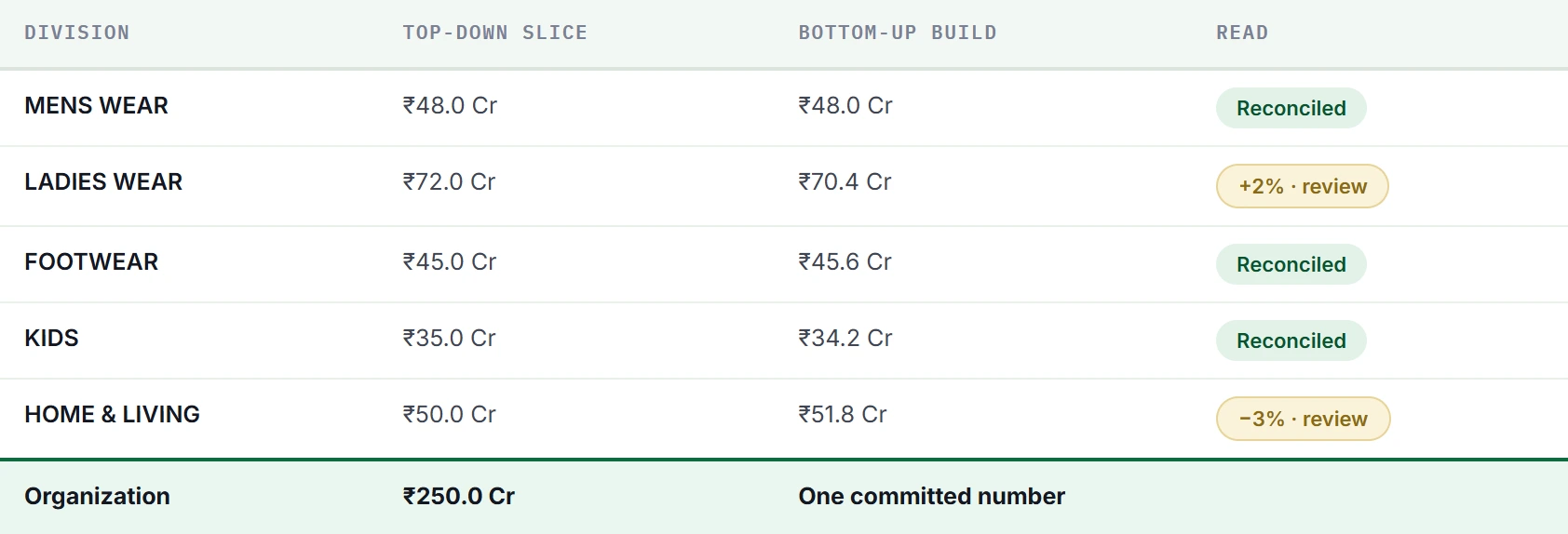
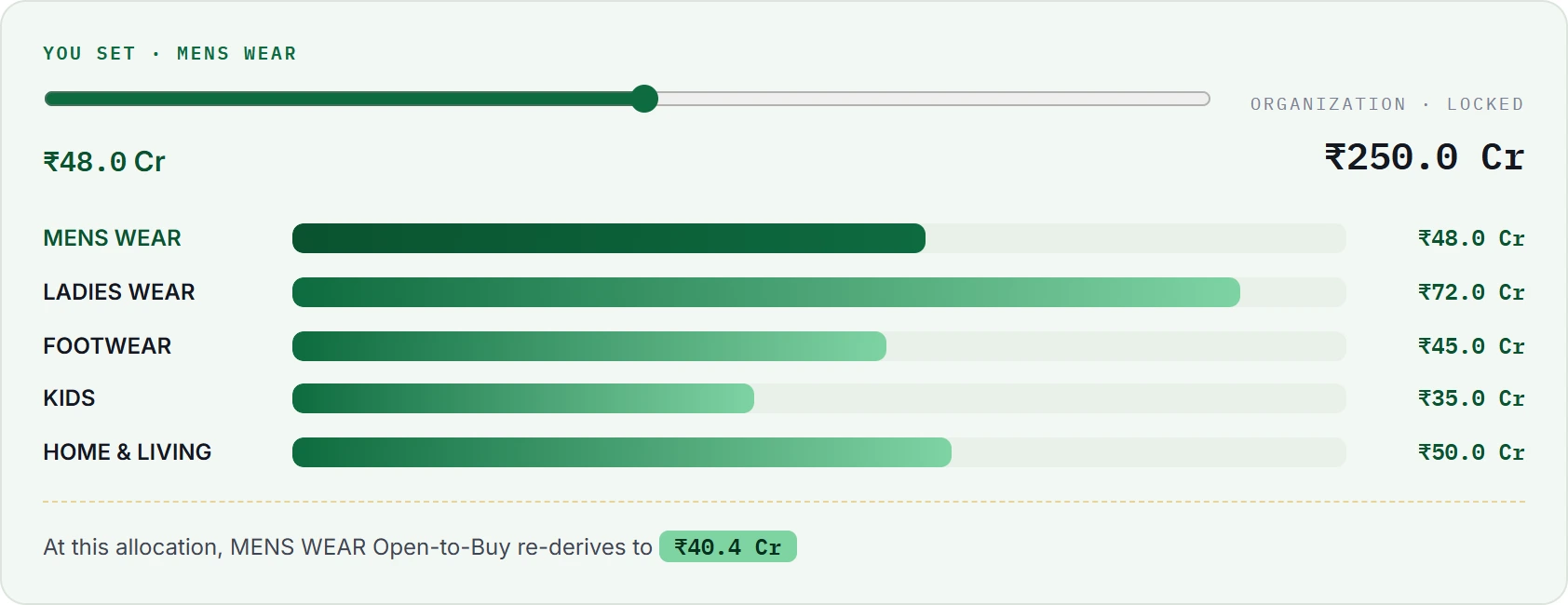
One level up, the same reconciliation happens between the organization and its divisions, and it is worth seeing because it is where planning either becomes one conversation or twelve arguments.